Wednesday, 20 March 2013

Question 1: In what ways does your media product use, develop or challenge forms and conventions of real media products?

To consider how our music video uses or challenges its genre it is important first to consider the specific genre and its conventions. The artist of 'Antiques' inspirations are key to discovering the intentional genre, for example the indie folk bands 'Beirut' and 'King Creosote and Jon Hopkins' are key influences for our own track. This would suggest that Billy Lubach (the artist for Antiques)'s work is from a similar genre. Therefore our own music video uses and then develops upon the conventions already notified through the work of these similar artists.
Beirut - Vagabond


In the music video Vagabond, the genre is confirmed through a sense of nostalgia which is created using a black and white colour scheme. The use of nostalgia helps confirm the genre in the sense that the natural acoustic sounds remind the audience of original cinema, therefore the nostalgic imagery links back to the specific acoustic folk genre. After confirming the genre of the track through the research into similar artists as indie folk it was important to discover the age demographic for our target audience so that we could structure the video in a way that appeals to them. After presenting several different age groups with the track the conclusion was that although the target audience is mainly in the younger generations the track appeals to all audiences. We therefore aimed to base our music video around silent films so as to confirm a sense of nostalgia and challenge the conventions of stereotypical music videos that are mainly performance based in order to appeal to the wide age demographic of our audience. Therefore, we used and developed the structure of silent films in order to identify with our audience and confirm the genre. 

The key way in which are media product develops the conventions of real media products is through the narrative structure used throughout the music video, we established this by referencing the basic structure of 'Alice in Wonderland' and then developing the dream like world that Alice finds herself in.
This allows our media product to interact with the younger section of our target audience (the 16 to 25's) by establishing the youths in the media product as being lost and threatened by society, this allows our audience to relate to the characters within the music video and grabs the audiences attention in a way that allows them to understand and appreciate the generic conventions of the product. Similarly the topic of alice in wonderland and the references to the original Tenniel artwork allows the older age demographic of our target audience to feel nostalgic as well as enjoy the developments of the products conventions.

The costumes for each character were influence by the forms and conventions of real media products, for example, the protagonist's costume is a merge between Dorothy's dress in 'The Wizard of OZ' and Alice's from 'Alice in Wonderland'. The costume for the Bunny comes from the traditional character of Mr. Rabbit from 'Alice in wonderland' which references to the dream world that the protagonist falls into but is developed to reference the animalistic danger of humanity represented in 'The Wicker Man', this is confirmed by only referencing the animal with a mask and by keeping the rest of the body as human.


Through using and developing these conventions we confirm the dreamlike state that the girl has found herself in, which allows the juxtaposition of the city landscape (which reflect the bleakness of reality) and the natural plantation to reflect a sense of nostalgia which in turn confirms the genre for the audience. By developing these conventions the audience also feels a sense of nostalgia for the video due to the recurring references to silent films. 
The use of camera angles and traditions is vital when considering how our own media product uses and develops the conventions of similar media products, the most important of which is our references to silent films which is presented best through our use of circular narrative. The use of a circular iris opening and closing the music video is a recurring motif throughout early silent films, this telescopic effect was used to confirm a circular narrative in order for the ending of each media product to be justified. By using this same effect in our own product we confirm the influence of the silent film as well as reflecting the idea that the protagonist escapes her dreamlike state and returns to reality which confirms the circular narrative of the production. The use of lighting throughout the dreamlike state is ambient which is used to reflect realism, however by using this in the dream world we challenge the conventions of other media products and contrast the dreamworld with reality causing the audience to be unsure which world is the protagonists true world.
Monday, 18 March 2013

Question 2: How effective is the combination of your main product with ancillary texts?

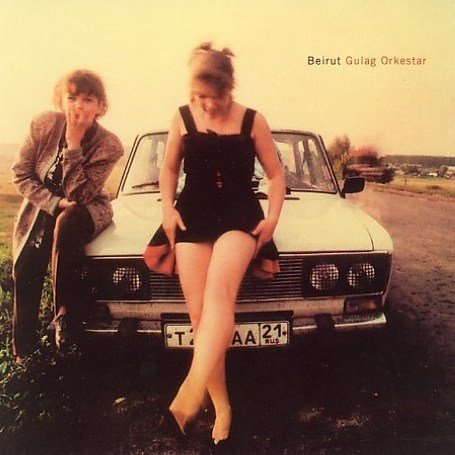
A vital step to take after completing the Music Video production was the creation of a Digipak and magazine advert in order advertise our media product to our target audience. The key to getting a set of images that represented the genre well was through our researc into other bands and artists of a similar genre. We first looked at musicians that had inspired the artist of our own track, the most important influence of which was Beirut.

 The majority of the artwork for Beirut's album covers uses a very bleak colour palette in order to represent a forgotten time, in the same way that the artists music is from a predated genre the album covers also reflect a sense of nostalgia. This links back to our own music video in the sense that we have developed the typical performance based style of a music video with the nostalgic structure of a silent film. Therefore to have artwork that relates to the genre as well as the music video we would need to use imagery and a colour palette that would reflect a sense of nostalgia for our target audience.
Panel 1:


The 1st panel utilises the recurring motif of the creature masks in order to link the digipak with key aspects of the music video and convey to the target audience the connection between the video and the digipak in order to promote the artists work. The colour palette of the 1st panel is equal to that utilised throughout the music video in order to confirm the 'wonderland' that the protaginist has fallen into, using the same natural imagery and colour scheme on both products helps link them together and promote the entire production in a coherent way.

Panels 2 & 3:

The 2nd and 3rd panels are one long landscape shot, that I utilised in order to confirm a strong link between the music video and the generic conventions of a silent film. The black and white colour palette uses the generic conventions of a silent film in order to continue to confirm the genre to the target audience, the hint of blue lining the background suggests the idea of reflecting on the past and nostalgia, which is a recurring theme throughout the music video.


In order to visually link an image with the music video I took a close up shot confirming the importance of the female protaginist from the music video and overlayed an image of several masked creatures in a field. This uses the recurring motif of the masked animals in order to confirm the connection to the music video in a coherent and visably appealing image.

Panel 4:

When designing the 4th panel for my digipak I considered the silent films that I'd researched, the strongest intertextual reference throughout our music video stems from the first film adaptation of Alice in wonderland, which without colour imagery meant that to represent a similar silent film link I would need to present the audience with a similiar mise-en-scene, therefore the final panel of the digipak was an extreme close up on a bottle of medicine.

This reference to 'Alice in Wonderland' will be an easy to recognise reference for our target audience and will reflect the audience with a sense of nostalgia in order to help confirm the predated genre that the album presents. The colour palette came from the curtains used in classic theatres when silent films were first presented. The rich red colour colour scheme is also a recurring motif throughout the music video in order to confirm the silent film connotations.

Magazine advert:

The magazine advert, like the digipak images, is directly linked to the music video in order to present the genre and artists work to the target audience in a successfully promotional way. The still used for the magazine cover is also used on the 2nd and 3rd panels of the digipak, this confirms the shot as the key image in the promotion for the album and is an easily recognisable image, it not only represents the genre but also links to the idea that the music video is structured as a short film rather than a peformace based video. The is made apparent because the promotional face of the artist is a recurring character rather than the artist himself. The recurring image of the girl allows the audience to recognise the recurring motifs in the promotional package thus giving the artist a coherent and marketable brand style. This allows the digipak, music video and magazine advert all link together in order to continue promoting the artists work.

Saturday, 16 March 2013

Question 3: What have you learned from your audience feedback?

To gain feedback on the media product that would help with the editing process I handed out questions to several people from the original intended audience of 16 to 20 year olds, I gained responses from both genders in order to get a rough idea of what the audience as a whole likes and dislikes about the music video before asking a wider age demographic. The image shown top right is the average response from males between 16-20, out of the 3 males asked these were the typical boxes ticked. The questions are brief and understandable in order to get responses quickly from the audience after they watch the music video. The average answer for females between 16-20  is shown bottom right, once again the viewers questioned from a specific age demographic and gender answered the same to each question. The difference between the male and female responses is visible in
the first 2 questions, which shows that the product appeals more to women than it does men, this meant that less specific questions needed to be asked in order for both genders to express personal opinions about the music video. This did however allow me to understand that the media product was appealing towards the target audience.


In order to gain specific responses from the target audience I asked for specific responses from males and females within a 16 - 20 age group, the general responses were positive. The female responses were similar to the statistics already gained from the survey which concluded that females between 16-20 enjoyed the track and music video the most. However the male
responses  (Alex and Jack) specifically noted things which did not work particularly well with the audience, The main criticisms were "hard to understand plot" and "shaking camera in some scenes". These critical responses allowed the construction of the music video to have a specific angle and through responses such as "strong scene changes and dissolves" we were able to edit the video in order to make the overall plot more understandable and to slow down important shots where the camera was particularly shaky. This helped remove as many issues effecting the male audience as possible and this helped influence the construction of the overall media product in a way that benefited the entire target audience.

After reconstructing aspects of the music video, I used the same system for critical analysis in order to tweak and perfect my print productions and magazine advert. By using audience feedback to steer the construction process I learnt how to create a product that was perfect for the target audience, this is best illustrated through the construction of my magazine advert (Original image shown on the left). Through asking different peers from the same age demographic I learnt that the majority felt that the image itself was good and "Quirky" but that "The quantity of text is overwhelming and poorly placed."
I therefore reconstructed the advert through what I'd learnt from the audience in order to appeal to a larger demographic and become a generally more visually appealing media product (The re-edited magazine advert is shown on the right).

Thursday, 14 March 2013

Question 4: How did you use media technologies in the construction and research, planning and evaluation stage?

Construction:

The advancements in technology have altered the way that I constructed and produced media products, one of the key changes to the industry caused by technological advancements is that of products construction. The technological improvements with editing software and cameras being the most important aspects.
The cameras used on the music videos are a vast improvement from those used on our previous thriller productions, the major difference here being the quality of the footage. The new HD Digital Cameras were able to record far more detail than the previous equipment, this allowed us to explore darker and locations and shots which had previously caused the footage to blur or lose focus. This severely improved the planning of the production and allowed us to utilise several high angle shots and zooms which would not have been possible without the technological advancements towards the media. Another improvement to the camera software was the fact that the footage was recorded onto an SD Card rather than straight to video, this allowed us to easily rewind and view footage without the fear of recording over previous footage. When comparing the HD digital cameras used in our media production to the 16mm film stock that were originally used in film productions the perks of the technological advancements become clear, the easy accessibility and playback ability have allowed the production of our music video to be much smoother and efficient than ever before.
When editing our raw footage we used Adobe Premiere Pro CS6 in order to construct our music video, this allowed the edition of effects and colour saturation which had previously not been a possibility, the use of such effects helped confirm generic conventions such as the 'circular iris' utilised at the beginning and end of the production, this helped confirm the generic opening to silent film, which without certain advantages to media technologies would not have been a possibility.
Another key piece of software is Adobe Photoshop, which allowed me to render and edit my print productions in a way that previous software had not, this allowed me to cut and edit several images that related to our Music Video into one single shot, this allowed me to confirm the idea that our protagonist was in a 'wonderland' without having to find a specific location that would create the same effect.

Planning and Research:

One of the key media technologies used throughout the planning of my media production was blogger, which allowed me to organise separate aspects of the planning process whilst being able to visibly link specific ideas to research into other music videos, it also allows the presentation of planning and evaluation to be easily visible to our media teachers which in turn allows feedback to be quickly obtained and worked upon, without the technological advancements which led to the blogging process, the presentation of my planning, evaluation and research would have caused the disruption of the actual production of the Music Video.
YouTube was a key feature of my research into the genre and other music videos, without easily accessible videos such as the early footage of the 1903 Alice in Wonderland the ability to present generic conventions and certain connotations would not have been a possibility.
Another key advance is that of Google as a whole, without the easily accessible web pages the locating and presenting of ideas would have rendered the blogs rather irrelevant, the ability to easily access hundreds of images to display and idea has allowed the planning and research of the music videos to become a smoother process than in previous years.

Evaluation:

The key advancements in media technologies that have helped improve the construction, research and planning of media productions are the advances made on the internet, without sites such as 'Blogger' the presentation of my research would not have been as influential towards my planning and the final construction of the music video. With all the information around my own production organised on the same screen as the planning I was able to greatly improve my overall production. As well as blogger, YouTube and Google allowed me to display all the ideas and theories around the media production in an easy to understand format which allowed me to easily obtain feedback which in turn allowed the production to strengthen. Without such improvements into this software the process at which I made my Media product would have been far more time consuming and would of resulted in a less appealing end product. Therefore, it is easy to conclude that the advancements in media technologies has positively improved the ability to construct and produce media products.